 English
 Deutsch
 Français
 Nederlands
 Español
SHOP AYAHUASCA RETREATS BLOG
Why Nature Heals: The Science of Awe and Mental Health

Stella Vance
October 10, 2026
Your ultimate guide to discover transforming ayahuasca and psychedelic experiences. Dive into serene destinations and elevate your consciousness to unparalled heights.
Discover Ayahuasca & Psychedelic Retreats NowSearch for ayahuasca & psychedelic retreats
Discover retreats, trainings, and holidays from all over the world
There's a reason the first thing people say after a week in the forest is some version of I feel like myself again. It's not just the fresh air, though that helps. It's not just the quiet, though that helps too. Something more specific happens when we spend real time outdoors — something researchers are only now beginning to measure with any precision. And it turns out the active ingredient might be a single, strangely underrated emotion: awe.
This matters more than it sounds. If you're reading about plant-medicine work, psychedelic retreats, or any serious attempt to address depression, addiction, or stuck patterns, the setting of the healing isn't incidental. Most of the deepest therapeutic traditions on Earth happen under a canopy of trees, beside a river, or on a mountainside. That's not a coincidence or an aesthetic choice. The container matters. And nature, as it turns out, is doing a lot of quiet work in the background.
Wilderness Therapy and the Return of an Old Idea
Over the past decade or so, wilderness therapy programs have multiplied — backpacking trips, river expeditions, climbing intensives, all paired with trained clinicians. They're being used for everything from treatment-resistant depression to adolescent behavioral issues to veterans carrying combat trauma home. Participants who've spent years cycling through traditional talk therapy sometimes crack open after four days on a trail. Facilitators who've run these programs for decades will tell you, almost sheepishly, that they're not entirely sure why it works. But it works.
Psychologists running these trips have long suspected that nature itself is part of the therapy, not just the backdrop. A growing body of research backs them up: green spaces lower cortisol, forest walks reduce rumination, and even a view of trees from a hospital window seems to speed recovery after surgery. That's a lot of effect for something as unglamorous as going outside.
But researchers kept running into the same question. What specifically is happening? Is it the exercise? The social bonding? The absence of screens? The sunlight? Some combination of all of it? One recent line of research suggests the answer might be more interesting than any of those alone.
The Study That Pointed to Awe
A team led by researcher Craig Anderson, working with Dacher Keltner's lab at UC Berkeley, took a close look at what emotion was doing the heavy lifting during nature experiences. Their first study followed military veterans and underserved youth on multi-day river rafting trips through the forested canyons of California's American River and the sandstone formations of Dinosaur National Monument in Utah. Participants paddled through rapids, slept under stars, and ate dinner around a fire for days on end.
Before and after the trips, researchers measured stress, mood, and life satisfaction. During the trips, participants kept nightly diaries noting what they'd felt that day — awe, amusement, gratitude, joy, peace, pride. The well-being gains afterward were significant, especially among the younger participants. But when researchers combed through the diaries looking for which emotion best predicted those gains, one feeling stood out above all the others. Awe.
Not peace. Not joy. Not even gratitude, which the wellness world has rightly been talking about for a decade. The specific sensation of standing in the presence of something vast — a canyon wall, a river carving through stone, a sky with more stars than you've seen since childhood — was the thing most tightly linked to feeling better.
You Don't Have to Climb a Mountain
Here's where the research gets genuinely useful. Anderson's team ran a second phase to see whether awe mattered in ordinary nature too, not just once-in-a-lifetime expeditions. They had undergraduates keep two weeks of daily diaries about any positive experiences they had, in nature or out of it. The pattern held. Students who'd spent time outside — even just a walk through a park, even just a few minutes watching the light hit a tree — reported higher life satisfaction that same evening. And again, awe predicted the lift better than any other positive emotion.
This is good news for anyone who can't drop everything and disappear into the Amazon for a month. You don't need a $4,000 retreat to access this mechanism (though a retreat certainly makes it easier). You need to actually notice. The flowering tree you walk past every morning. The way the clouds build up before a storm. The ridiculously ordinary miracle of a sunset you usually see through a windshield.
A few practical ways people seem to catch awe in daily life:
- Walking somewhere new, even in your own neighborhood, with your phone in your pocket
- Looking up — literally — at the tops of tall trees or the night sky
- Sitting with a body of water for ten minutes without doing anything
- Watching weather roll in instead of checking a forecast app
- Going outside before sunrise, which almost nobody does, and which almost always delivers
The Small Self and Why It Matters for Healing
Anderson's working theory for why awe moves the needle so dramatically is something called the small self. When we encounter something immense — geological, cosmic, oceanic — our sense of our own problems contracts. The worry that was eating you alive at 2 a.m. feels, briefly, like what it actually is: one small knot inside a very large and ongoing world. The ego goes quiet. Not gone, just quieter.
Anyone who has sat in an ayahuasca ceremony will recognize this immediately. The small self is one of the most consistently reported features of a deep plant-medicine experience — the dissolution of the usual boundaries, the sudden perspective on patterns that had seemed permanent, the humbling and strangely liberating sense that you are part of something enormous. Ayahuasca, psilocybin, and the other master plants seem to open that door chemically. Nature opens the same door more gently, and without the risk, without the dieta, without the three-hour vomit. Both appear to work on overlapping psychological territory.
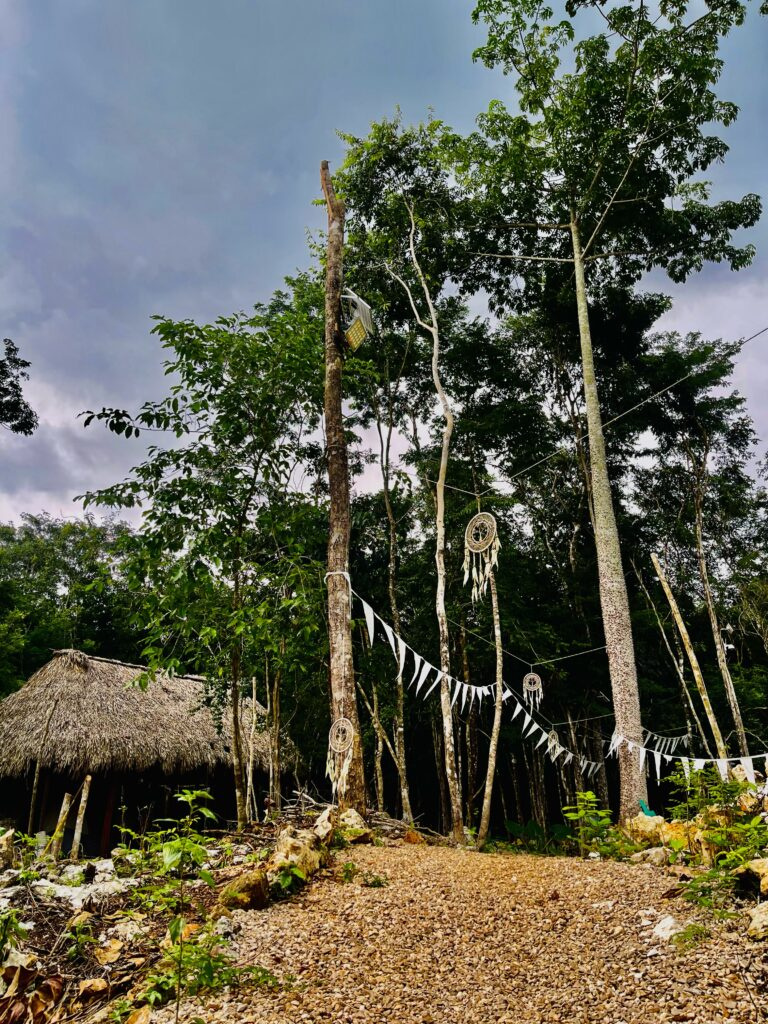
This is probably why serious retreat centers — the ones worth going to — are built in forests, by rivers, on remote coasts. The plant does its work, but the setting is doing work too. You wake up to birds instead of traffic. You walk barefoot on earth that hasn't been paved. Your nervous system, which has been in low-grade combat with city life for years, finally gets permission to stand down. Then the medicine arrives, and the two work together.
What This Means If You're Considering a Retreat
If you're weighing whether to book a psychedelic or plant-medicine retreat for help with depression, addiction, trauma, or just a life that feels stuck, pay close attention to where it's held. A ceremony in a converted office building in a city is not the same as a ceremony in a jungle maloca with howler monkeys in the canopy. The medicine might be identical. The experience will not be.
Ask the facilitators how much time participants spend outside between sessions. Ask about the land — is there anywhere to walk, to sit by water, to be alone with trees? The integration days, the quiet hours between ceremonies, are often where the deepest shifts settle in. And that settling happens best outside, where the small self the medicine opened up has room to breathe.
It's also worth saying: you don't need to wait for a retreat to start this work. The research is pretty clear that the mental-health benefits of nature compound daily. If you're in a difficult stretch — the kind of stretch that has you reading about plant medicine in the first place — committing to twenty minutes outside each morning, phone off, is one of the cheapest and most reliable interventions available. It won't fix everything. Nothing fixes everything. But it will move you.
A Quieter Kind of Medicine
There's a tendency in the psychedelic space right now to treat the medicines as the whole story. The brew, the mushroom, the molecule — as if the healing lives inside the chemical. It doesn't. The healing lives in the relationship between a prepared person, a wise facilitator, a safe container, and a setting that lets the nervous system actually rest. Nature is one of the oldest, cheapest, and most reliable parts of that container. The research is just catching up to what every shaman already knew.
So before you book anything, go outside. Really outside. A park counts, a backyard counts, a stretch of coastline counts. Pay attention to what happens in your body when you look up at something bigger than you. If something stirs — curiosity, quietness, the faint sense that the problem you've been carrying isn't quite as total as it felt yesterday — you're already in the territory the plants will take you deeper into.
For readers who want to take this further, a range of plant-medicine and psychedelic retreats held in genuinely wild and awe-rich places can be browsed on our marketplace here. Choose a setting that matches the depth of the work you're there to do.

Craving More Stories?
Join our ShopAyahuascaRetreats newsletter for the latest updates on thrilling
destinations and inspirational tales, delivered straight to your inbox!
We value your privacy. Your email address will never be shared or published.