 English
 Deutsch
 Français
 Nederlands
 Español
SHOP AYAHUASCA RETREATS BLOG
Sitting With Grief: A Contemplative Path Through Loss and Disconnection

Ivy Chan
June 26, 2026
Your ultimate guide to discover transforming ayahuasca and psychedelic experiences. Dive into serene destinations and elevate your consciousness to unparalled heights.
Discover Ayahuasca & Psychedelic Retreats NowSearch for ayahuasca & psychedelic retreats
Discover retreats, trainings, and holidays from all over the world
There's a particular kind of heaviness a lot of people are carrying right now. It doesn't have a name or a date attached. No funeral, no breakup, no obvious wound — just a low static of sorrow humming underneath the ordinary day. You wake up tired in a way sleep won't fix. You scroll through the news and feel something tighten in your chest, then immediately distract yourself. You miss something you're not sure you ever actually had.
I've come to think this kind of grief is real, and that it has a source — even if it resists easy explanation. It's what it feels like to be a living, sensing creature inside systems that are quietly coming apart: ecological, social, relational, spiritual. And it's what it feels like to keep moving too fast to actually register any of it. The body knows. The body always knows. The question is whether we're willing to listen.
The Grief That Has No Name
Modern life has been organized around a story so old we've stopped noticing it: that humans are somehow separate from the natural world. Rivers became infrastructure. Forests became timber. Soil became a substrate for yield curves. Even our own attention has been turned into a commodity to be harvested. The story has produced extraordinary things — antibiotics, air travel, the ability to read this sentence on a glowing rectangle — but it has also produced a rupture. A quiet, civilizational tear between us and the living systems that actually keep us alive.
Here's the thing. The body keeps a different ledger than the culture does. Something in us still knows we're not separate — that we're made, quite literally, from the water, air, and slow accumulated intelligence of ecosystems that have been writing themselves for millions of years. When that knowing is overridden long enough, grief is one of the ways it surfaces. Not as a tidy emotion but as a fog. As anxiety that won't quite resolve. As a craving for meaning that no amount of productivity quite satisfies.
People sometimes call this ecological grief or climate grief. Those names point at something real but they're also too narrow. The grief I'm describing is broader — it's the grief of disconnection itself. From land. From neighbors. From the slow rhythms of bodies and seasons. From a sense of being part of something larger than the next quarter.
What Buddhist Wisdom Has to Say About All This
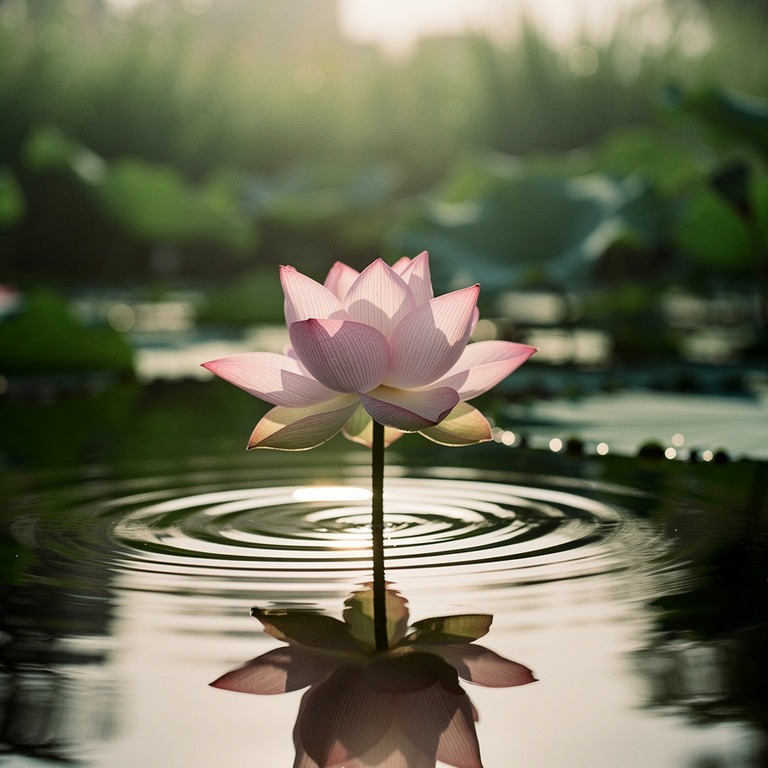
There's an image from Buddhist cosmology I keep coming back to: Indra's Net. Picture a vast web stretching infinitely in every direction. At each intersection of the web, a jewel. And in each jewel, the reflection of every other jewel. Nothing stands alone. Each point contains and is contained by the whole. Thich Nhat Hanh called this interbeing — the recognition that a flower contains the cloud that rained on it, the soil that fed it, the sun that reached toward it across ninety-three million miles.
What's interesting is that this isn't only a contemplative teaching anymore. Ecology, systems science, complexity theory — they're all saying versions of the same thing in different vocabularies. Cut down a forest in one region and rainfall patterns shift hundreds of miles downwind. Disturb a soil microbiome and the mental health of the people eating from it changes. Pull on any thread and the whole fabric moves. Separateness was always the illusion. We just built a civilization on top of it and called it common sense.
The crises we're living through — climate disruption, species collapse, the slow unraveling of social trust — aren't separate problems to be solved one at a time. They're different expressions of the same foundational confusion. Which means the response can't only be technical. It has to include a different way of feeling ourselves inside the world.
Why Grief Is Actually a Resource
This is the part that took me years to understand, and I'll say it plainly: grief is evidence of connection. It means you haven't gone fully numb. It means that somewhere beneath the coping, the scrolling, the forward motion, something in you still recognizes what's being lost. You wouldn't grieve what you weren't already, in some sense, part of.
We turn away from grief by staying busy. By optimizing. By staying productive enough not to feel it. And in doing so we lose something important — not because suffering is virtuous, but because grief, when we can actually be present with it, keeps us in contact with what matters. Grief is the feeling of caring. And caring is what makes it possible to act from something other than fear, obligation, or habit.
This is one reason so many people who sit with plant medicines like ayahuasca, psilocybin, or San Pedro describe their experience as grief work rather than recreation. The medicines don't deliver insight on a platter. They tend to dissolve the armor we've built around feelings we've been outrunning — sometimes for decades. What rises up is often the very thing we've been organizing our lives to avoid. And underneath it, frequently, is love. The love of what's real. The love of being part of something.
Practices That Help You Stay
Contemplative traditions have understood for a long time what modern life keeps forgetting: presence is a skill. The ability to remain with what's actually happening — pleasant, painful, confusing, all of it — isn't a personality trait. It's trained. You build it the same way you build any other capacity: by doing it, repeatedly, badly at first, until something in you changes.
A few practices that genuinely help with this kind of grief:
- Sitting meditation. Twenty minutes a day, eyes soft, breath ordinary. Not to empty the mind — that's a misunderstanding — but to learn that you can feel something difficult without immediately needing to fix or flee it.
- Walking in a place that doesn't belong to you. A forest, a riverbank, a stretch of coast. Move slowly enough that the place starts to feel like a presence rather than a backdrop.
- Daily noticing. Pick one ordinary object or surface and look at it for sixty seconds. The way light falls. The texture. What it has weathered. This is more powerful than it sounds.
- Making something with your body. Painting, cooking, gardening, building — anything that requires the kind of attention that thinking alone can't perform.
- Plant-medicine retreats, when undertaken seriously. Ayahuasca and other traditional medicines, held in legitimate ceremonial containers with experienced facilitators, can open doorways into grief that conventional therapy sometimes can't reach. They're not for everyone. They require real preparation, real integration, and real respect.
What all of these share is a particular quality. The willingness to be with what is, rather than only what you wish were there. To let grief and beauty and uncertainty share the same room without insisting one cancel the others.
The Time That Runs Underneath
Something else changes when you start practicing this way. Time itself starts to feel different. The compressed, optimized, every-minute-monetized time of modern productivity loosens its grip a little. Underneath it, you start to notice an older rhythm — cyclical rather than linear, attentive to recurrence, growth, loss, return. The time of seasons. Of bodies healing. Of forests recovering. Of grief itself, which moves on its own schedule and doesn't take meeting requests.
To slow down enough to feel that rhythm is to reconnect with the depth from which any meaningful response comes. Quick action from a place of disconnection mostly produces more of what created the problem in the first place. Slower action — even slightly slower — from a place of genuine contact has a different quality. It tends to be wiser. Less frantic. More likely to actually help.
This is, in part, why the integration period after a retreat matters as much as the ceremony itself. The ceremony can shake something loose. But it's the slow weeks and months afterward — the sitting, the journaling, the long walks, the difficult conversations — where the shift actually settles into a life.
What This Means If You're Considering a Retreat
If you've been quietly researching ayahuasca or another plant-medicine retreat, and you're not entirely sure why, I'd gently suggest this: the unnameable grief might be part of the reason. Most people don't book a retreat because everything is going great. They book one because something has been asking for attention that the ordinary tools of life haven't been able to address.
A few honest things worth knowing before you go:
- Choose the container carefully. The facilitator, the tradition, the lineage, the screening process — these matter more than the destination or the price. A reputable retreat will ask you difficult questions about your medical history and your mental health before they accept you. If they don't, that's information.
- Prepare your body. The traditional dieta exists for reasons that go beyond superstition. Cleaning up what you eat, drink, and consume in the weeks leading up to a ceremony genuinely changes the experience.
- Plan your integration before you go. Therapist, integration circle, trusted friend — line it up in advance. The week after the ceremony is when the actual work begins.
- Don't expect a fix. What these experiences tend to offer is contact — with grief, with love, with something larger. What you do with that contact afterward is the real medicine.
Coming Back to Where We Started
Indra's Net works in both directions. If every point in the web reflects every other, then changes in how we understand ourselves don't stay private. They move outward. They shape which questions get asked, which trade-offs get accepted, which futures feel possible. Personal practice and collective transformation aren't separate categories. They're the same web, felt from different angles.
When grief is held rather than avoided, it tends to move. Not vanish — grief doesn't really vanish — but transform. It softens into something closer to love. The love of what's real. The love of what's actually here. The love of what we're genuinely part of, whether we remember it or not.
For readers who feel pulled to take this work further in a structured setting, a range of curated plant-medicine and ayahuasca retreats can be browsed on our marketplace here. Whatever you choose, the practice — really — is the same. Come back to what's here. Come back to what you're already part of. Again and again, with the heart as open as you can manage.


Craving More Stories?
Join our ShopAyahuascaRetreats newsletter for the latest updates on thrilling
destinations and inspirational tales, delivered straight to your inbox!
We value your privacy. Your email address will never be shared or published.