 English
 Deutsch
 Français
 Nederlands
 Español
SHOP AYAHUASCA RETREATS BLOG
Sacred Dance as Offering: How Movement Becomes Prayer in Vajrayana Buddhism
Liam Beckett
August 26, 2026
Your ultimate guide to discover transforming ayahuasca and psychedelic experiences. Dive into serene destinations and elevate your consciousness to unparalled heights.
Discover Ayahuasca & Psychedelic Retreats NowSearch for ayahuasca & psychedelic retreats
Discover retreats, trainings, and holidays from all over the world
Picture a candlelit prayer hall in the mountains. Silk robes in saffron and cerulean sweep past a painted mandala. Sixteen dancers step in a slow grapevine pattern, each holding a scarf mounted with an instrument, a flower, a vial of perfume. A chant master intones the liturgy. Hands trace shapes in the air that most onlookers would never recognize as language — but they are.
This is not performance. It's offering. And once you understand what's actually happening inside these Himalayan dances, the whole idea of what a spiritual practice can look like quietly cracks open.
What Is Sacred Dance in the Vajrayana Tradition?
In Vajrayana Buddhism — the tantric branch that took root across Tibet, Bhutan, Nepal, and parts of the Indian Himalayas — nothing is wasted. Every action, gesture, and breath can be turned toward awakening. That includes dance. The technical term is cham, and it appears in nearly every major ritual context you can name: welcoming a teacher, invoking a deity, closing a multi-day ceremony, celebrating a retreat's end, praying for a lama's long life.
The late Nyingma master Thinley Norbu Rinpoche once put it plainly: in this tradition, every movement can become virtue. That's the whole conceptual engine. You take an ordinary human capacity — the body's ability to move in rhythm — and you dedicate it. Multiply it through visualization. Send it outward as an offering to enlightened beings, and then dissolve the whole thing back into emptiness. What's left is merit, presence, and a room full of people who feel something shift.
A Bhutanese cham master once explained the appeal this way: gods and humans both love dance, the same way they love flowers. Nobody, he said, can resist the beauty. That's the invocatory logic — beauty calls presence into a space.
Welcoming Teachers with Movement
In Bhutan, when a senior lama, a king, or a distinguished guest arrives at a monastery or public teaching, they aren't greeted with a handshake. They're greeted with a dance called Jipai Pawo Cham — the Majestic Hero's Dance. Two or four pawo, or heroes, flank the arriving guest, hopping and bounding alongside them, rattling small hand drums called damaru. When the procession reaches the reception area, the dancers pivot and perform the full choreography — peaceful, semi-wrathful, and wrathful sections in sequence — while a libation is offered.
There's something almost startling about seeing this the first time. In our part of the world, formal greetings tend toward the muted and the transactional. Here, arrival itself is treated as a sacred moment worth marking with sound, motion, and unabashed joy. The dance essentially tells the space: pay attention, something meaningful is happening.
Guru Padmasambhava — the eighth-century Indian tantric master who carried Buddhism across the Himalayas — is invoked at Tsechu festivals and prayer gatherings with a cham called Zheng Zhik Pema. Dancers costumed as dakas and dakinis spin and leap while sounding their drums, reciting a liturgy said to summon the Guru instantly. And when the day's ceremony winds down, another dance — Kadrinchenma Cham — closes it out with an unmistakable emotional charge: gratitude, longing, and the wish to see the teacher again.
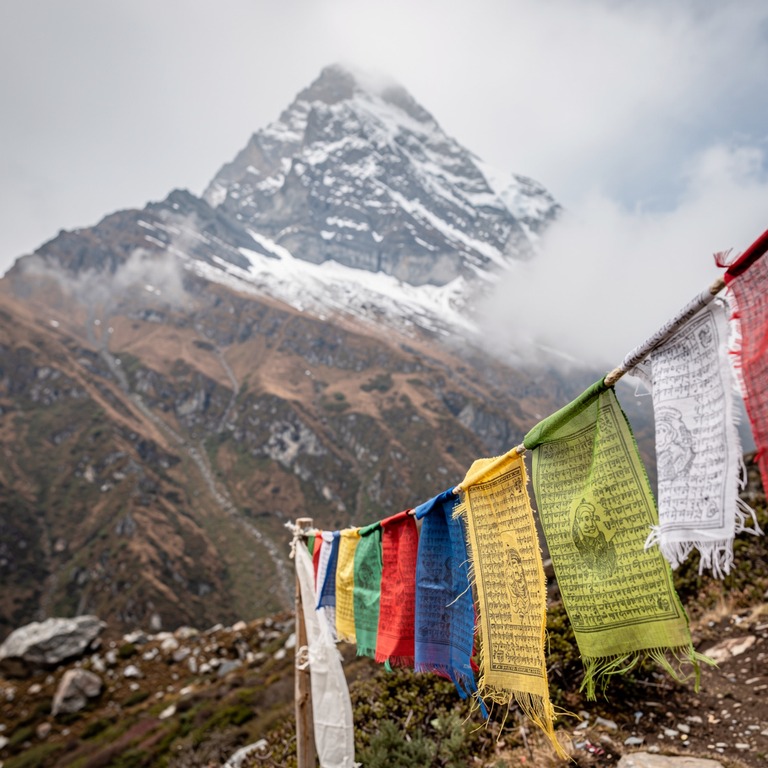
Dance to Increase Auspiciousness
The Drukpa Kagyu tradition, under His Holiness the Twelfth Gyalwang Drukpa, has taken this approach further than most. Their nine-day Avalokiteshvara Drupchen at Druk Amitabha Mountain in Kathmandu is packed with cham dances — some added to the ritual text specifically to boost the auspiciousness of the whole event. And they work. There's a preparatory hum in the air before each dance, a rippling quiet after, and the accumulated effect over nine days is difficult to describe to someone who hasn't sat inside it.
The same nuns and monks perform another genre entirely: gurma, or songs of realization. These are folksy, delightful choreographies set to verses that celebrate spiritual life — often composed by lineage masters centuries ago. Gurma get offered at pujas, formal teachings, temple consecrations, and lineage anniversaries. They're also offered when someone completes a long retreat. Imagine walking out of three years of silent practice and being welcomed back into the community by a circle of your peers dancing in your honor. That's the texture of this tradition.
- Cham — highly formal, choreographed ritual dance, usually performed in ceremonial costume with masks or crowns.
- Gurma — folk-inflected dances set to songs of spiritual realization, often lighter and more communal in feel.
- Charya nritya — the Newar Buddhist yogic dance tradition of the Kathmandu Valley, closer to classical South Asian dance vocabulary.
The Vedic Roots Beneath the Choreography
None of this appeared from nowhere. The Vedic period — roughly 1500 to 1200 BCE — laid down the substrate for much of what became Buddhist ritual. The Yajur Veda already references rhythmic mantra recitation woven into ceremony. By the time Vajrayana deity yoga was systematized by Indian commentators around 700 CE, the elaborate apparatus of mudras, visualized offerings, and celestial goddesses who multiply those offerings was fully in place.
In Nepal's Kathmandu Valley, where the Newar people have preserved a distinctly South Asian flavor of Vajrayana practice, the priestly caste of vajracharyas has kept a yogic dance tradition alive for at least a thousand years. It's called charya nritya — literally, dance as a spiritual discipline. One of its signature pieces, Sodasha Lasya, has the practitioner embody sixteen offering goddesses in sequence. You strum an imagined lute. You mime placing a mala around a deity's neck. You send scent from an invisible incense bundle outward through space. The line between performer, offering, and offered blurs by design.
The Tibetan and Bhutanese cousins of this dance appear under the name Rigma Chudruk Cham — Dance of the Sixteen Wisdom Goddesses. Each lineage has its own iteration, but the visual signature is consistent: silk brocade robes, bone ornaments, an apron, wristlets, armlets, a chest emblem, a crown. For centuries these dances were performed only by monks dressed as female wisdom beings, because monks staffed the institutions where the rituals happened. It's only in roughly the last twenty years that women practitioners have been invited to perform dakini cham — both within Himalayan nunneries and at a small number of Dharma centers in the East and West.
The Longevity Dance and What It Really Means
Here's a corner of the tradition that took me a while to sit with. In Himalayan Buddhism, students frequently compose and recite prayers requesting that their teachers remain in this world. The reasoning is direct: a living teacher is a student's best chance at awakening. But the tradition also holds that dakinis and other celestial beings actively summon great teachers to leave this life for other buddha realms. There's a cosmic tug-of-war going on.
Khandro Denga Cham, sometimes called Khandro Tenzhug — the Long Life Prayer to the Dakinis — is performed as an offering to those celestial beings, essentially asking them politely to hold off. The Karma Kagyu nuns of Karma Drubdey Nunnery in Trongsa, Bhutan, dance it to welcome yoginis returning from long retreat, alongside a gurma set to lyrics by the eleventh-century yogi Milarepa. It's a stunning theological move when you think about it: the sacred is negotiated with, not just supplicated. And the medium of negotiation is choreography.
Dancing Good Wishes into the World
Most large Drukpa Kagyu ceremonies close with a gurma called Tashi Cham. Where a standard prayer service ends with a spoken benediction extending auspiciousness to all beings, the Drukpa monastics dance the benediction instead — with real gusto. Each dancer holds streamers in the five colors of the elements and the five wisdoms. They spin them like enormous paint brushes through the air. Feet stomp negativity into the ground. Arms lift joy upward. The lyrics describe the Five Wisdom Buddhas arriving from the five directions to distribute good fortune, and each verse ends with the refrain: how delightful and joyful.
That refrain is worth pausing on. So much of what we call spiritual practice in the West gets framed as a solemn, sit-down affair — jaw tight, back straight, eyes closed, working on ourselves. The Himalayan traditions have kept alive an older, wilder possibility: that awakening includes celebration, and that the body celebrating is itself a valid instrument of practice.
Why This Matters if You're Considering a Retreat
You may be reading this because you're weighing a contemplative retreat — silent meditation, plant medicine, a monastic stay, something in between. It's worth knowing that the map of contemplative practice is wider than the two or three modalities most Westerners hear about. Sacred dance sits inside that map. So do body-based practices like prostrations, chanting, ritual visualization, and the elaborate offering ceremonies described above. Some retreats in the Nepal and Bhutan circuits include a full immersion in cham or gurma alongside sitting practice, and a handful of Dharma centers in North America and Europe teach charya nritya to lay practitioners.
If any of this resonates — the idea that devotion could be embodied rather than only internal, or that ritual practice might be as much about beauty as about discipline — it's worth asking what tradition you're drawn to, what preparation the practice requires, and whether the retreat you're considering treats these forms as living lineage or as decoration. Good centers will tell you honestly which teachers they trained with and what the boundaries of their permission are.
For readers who want to take this further, a range of contemplative and plant-medicine retreats — many of which weave in the ritual, ceremonial, and body-based traditions touched on above — can be browsed on our marketplace here. The path in isn't always the one you expected. Sometimes it looks like sitting still. Sometimes it looks like a room full of silk robes moving in a slow, deliberate circle around a painted mandala, and the whole thing is prayer.
Craving More Stories?
Join our ShopAyahuascaRetreats newsletter for the latest updates on thrilling
destinations and inspirational tales, delivered straight to your inbox!
We value your privacy. Your email address will never be shared or published.