 English
 Deutsch
 Français
 Nederlands
 Español
SHOP AYAHUASCA RETREATS BLOG
Brain Bubbles and Beyond: Why Psychedelic Art Matters for Integration
Lila Novak
July 12, 2026
Your ultimate guide to discover transforming ayahuasca and psychedelic experiences. Dive into serene destinations and elevate your consciousness to unparalled heights.
Discover Ayahuasca & Psychedelic Retreats NowSearch for ayahuasca & psychedelic retreats
Discover retreats, trainings, and holidays from all over the world
A friend once handed me a spiral notebook the morning after her first ayahuasca ceremony. Inside were maybe forty pages of what she called “brain bubbles” — overlapping spheres, tendrils, small figures peeking out from behind geometric scaffolding. She couldn't explain any of it. She just knew she had to get it out of her head before breakfast, or she'd lose it forever.
That impulse — to draw, scribble, sketch, paint, or scrawl something down after a psychedelic experience — is older than most retreat centers and more useful than most integration workbooks. And yet almost nobody who books an ayahuasca retreat or a psilocybin sit thinks of themselves as an artist. They think they're going to heal something. Which they might. But the healing often happens in the marks they make on paper afterward, not in the ceremony itself.
What Happens When You Try to Draw a Vision
Psychedelic experiences resist language. That's not a poetic claim — it's a structural one. The brain regions that produce coherent speech go quiet during a peak experience with ayahuasca, psilocybin, or DMT, while the regions that handle raw sensory patterning, emotion, and spatial imagery light up like a switchboard. So when you come down and try to tell someone what happened, you sound like a broken translator. You reach for words. The words don't fit.
Drawing sidesteps the problem. A pencil doesn't need syntax. You can put a shape on paper that meant something to you at 3 a.m. in the maloca without having to defend or explain it. The shape holds the memory in a way sentences can't. Weeks later, you can look at the sketch and remember not just what you saw, but what it felt like — which is the part that actually matters for integration.
This is why so many people who've sat with master plants end up with journals full of strange doodles. Not because they woke up talented. Because drawing turned out to be the only tool for the job.
Why Integration Is the Real Work
The ceremony gets all the attention. Ayahuasca retreats sell the ceremony. Documentaries film the ceremony. Instagram accounts post about the ceremony. But talk to anyone who's done serious plant-medicine work and they'll tell you: the ceremony is maybe 20% of it. The integration is the other 80%.
Integration is what happens in the weeks and months after you come home. It's the process of taking whatever the medicine showed you — a memory you'd buried, a pattern you keep repeating, an old wound, a strange sense of connection with something larger — and actually weaving it into how you live. Without integration, insights fade. People go on a retreat, feel reborn for two weeks, then slide back into the same job, same relationship, same drinking habit, same numbness. The medicine didn't fail them. Integration did.
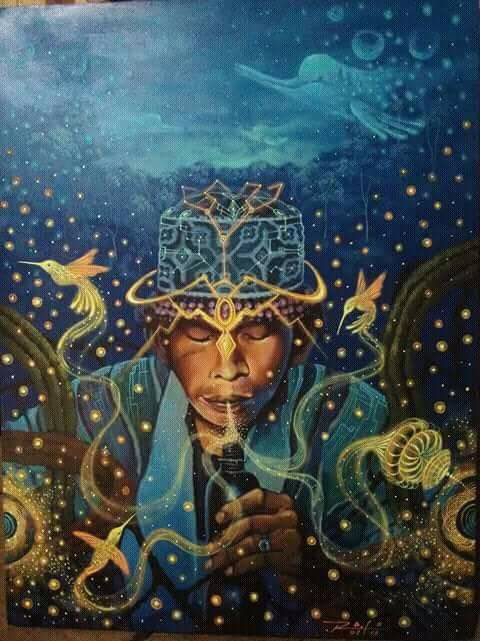
Art-making is one of the oldest and quietest integration practices there is. Long before someone coined the term “psychedelic integration,” Shipibo women in the Peruvian Amazon were embroidering the patterns they saw during their ayahuasca work into textiles. Those geometric designs — the ones you see hanging in every jungle lodge — aren't decoration. They're field notes.
What Kind of Art Actually Helps
Here's the good news: you don't have to be able to draw. At all. The whole point is not to make something beautiful. It's to externalize something internal so you can look at it, sit with it, and slowly come to understand it. Stick figures are fine. Scribbles are fine. Watercolor blobs with no discernible subject are fine.
A few forms that tend to work well for people processing psychedelic experiences:
- Mandala-style drawings — circular, symmetrical patterns. Great for processing overwhelming visions because the structure contains the chaos.
- Free-associative sketching — put pen to paper and don't lift it for ten minutes. See what emerges.
- Color-only paintings — no shapes, just the colors that dominated your experience. Surprisingly effective at recalling emotional tone.
- Comic-strip journaling — panels that show the arc of the journey. Useful for people who process narratively.
- Collage — for those who freeze at a blank page. Cut, arrange, glue.
Whatever the form, the trick is to work quickly and without judgment. The moment you start critiquing your own line quality, you've stopped integrating and started performing. If that happens, put the pen down and come back tomorrow.
The Addiction and Trauma Angle
A big chunk of people booking psychedelic retreats right now are doing it because talk therapy hit a wall. Long-standing depression, treatment-resistant PTSD, alcohol dependence, opioid dependence, the kind of anxiety that doesn't respond to anything — these are the reasons plant medicine has moved from counterculture curiosity to legitimate clinical interest over the past several years. Ibogaine for opioid dependence. Psilocybin for depression. Ayahuasca for trauma and grief. The evidence keeps stacking up.
But here's what the clinical papers don't always emphasize: for the addiction and trauma population, art-making after the experience isn't optional. It's often the safest way to approach material that words can't yet touch. Trauma lives partly in the body and partly in image-memory. It doesn't fit neatly into a therapist's paraphrase. When someone finally sees the shape of what they've been carrying — draws it, paints it, sculpts it in clay — something in their nervous system starts to relax. The thing is no longer only inside them.
Good retreat centers know this. The reputable ones build art-making into their integration circles alongside sharing, breathwork, and time in nature. If a retreat you're researching skips integration entirely and just runs back-to-back ceremonies, that's a signal worth paying attention to.
How to Start Your Own Practice, Even Without a Retreat
You don't need to have booked anything to begin. If you're currently weighing a retreat and want to try something honest and low-stakes in the meantime, this works:
- Get a cheap sketchbook. Nothing fancy — the nicer the paper, the more you'll freeze up.
- Pick a time when you're a little tired or a little dreamy. Early morning, right before bed.
- Set a timer for fifteen minutes.
- Draw whatever wants to come out. No planning. No erasing.
- When the timer ends, write two or three words on the page. Not an explanation — just the emotional weather.
- Close the book. Don't show anyone. Come back in a week and look at what you made.
Do this for a month and you'll start to understand what integration feels like from the inside. You'll also arrive at any future ceremony with a practice already in place, which matters more than most first-timers realize. The people who get the most out of plant medicine tend to be the ones who were already doing some kind of inner work before they showed up.
A Word on Sharing Your Art
The internet is full of psychedelic art. Reddit threads, Instagram grids, whole subreddits dedicated to “this is what I saw.” Some of it is stunning. Some of it is deeply personal in a way that maybe shouldn't be public. Your call.
My honest suggestion: keep the first year of your work private. Not because it's not good — because the meaning of it will shift as you integrate, and other people's reactions can lock it into an interpretation before it's ready to be interpreted. Once you've lived with the images for a while, share what feels right. The rest is yours.
Plant medicine gives you raw material. What you do with it is a slower, quieter project — one that unfolds through pens and paper and paint as much as through any single night in ceremony. For readers who want to take this further, a range of curated ayahuasca and psilocybin retreats with real integration support can be browsed on our marketplace here. Bring a sketchbook.
Craving More Stories?
Join our ShopAyahuascaRetreats newsletter for the latest updates on thrilling
destinations and inspirational tales, delivered straight to your inbox!
We value your privacy. Your email address will never be shared or published.