 English
 Deutsch
 Français
 Nederlands
 Español
SHOP AYAHUASCA RETREATS BLOG
Where Does the Insight in an Ayahuasca Ceremony Actually Come From?
Luca Reeves
September 9, 2026
Your ultimate guide to discover transforming ayahuasca and psychedelic experiences. Dive into serene destinations and elevate your consciousness to unparalled heights.
Discover Ayahuasca & Psychedelic Retreats NowSearch for ayahuasca & psychedelic retreats
Discover retreats, trainings, and holidays from all over the world
Ask anyone who's sat through a full ayahuasca ceremony and they'll tell you the same odd thing: the information doesn't feel like it comes from you. A memory surfaces you'd forgotten for thirty years. A voice — not quite a voice — tells you exactly why you keep picking the wrong partners. A geometry unfolds behind your eyelids and somehow, inside that geometry, is the answer to a question you never consciously asked. So where is all of this coming from?
It's the question that keeps people up at night after their first ceremony, and honestly, it keeps facilitators, neuroscientists, and curanderos arguing too. There's no single tidy answer. But there are several serious ways to think about it, and most people who work with ayahuasca eventually hold two or three of them at once. Let's walk through them.
The Neuroscience Answer: Your Brain, Rewired for a Few Hours
The most conservative explanation is also, frankly, the most testable. DMT — the active molecule in ayahuasca, kept alive in your bloodstream by the MAO inhibitors in the caapi vine — dramatically changes how your brain talks to itself. Regions that normally don't communicate start firing together. The default mode network, which handles your sense of self and your ongoing internal narrative, goes quiet.
When that narrator shuts up, other things get heard. Memories stored in the body. Emotional patterns you've been managing rather than examining. Associations your everyday thinking would normally suppress because they don't fit the story you tell about yourself. In this reading, ayahuasca isn't bringing information in from the outside — it's letting you access what was already there but locked behind a wall of habit.
This explains a lot. It explains why so many insights, once you sit with them, feel obvious in retrospect. Of course you've been avoiding grief since your father died. Of course the drinking started around the divorce. The medicine didn't tell you something you couldn't have known. It just cleared the noise so you could hear it.
The Traditional Answer: The Plants Are Teachers
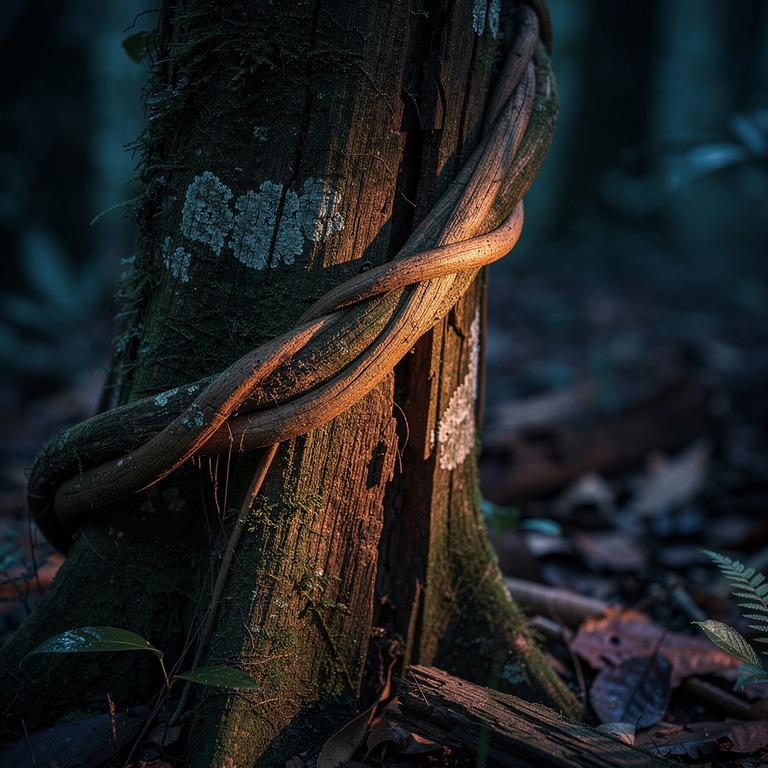
Amazonian curanderos would find the neuroscience take partial and a little sad. In the traditions where ayahuasca originates, the brew isn't a chemical key that unlocks your own material. It's a doorway to relationships with intelligences that live in the plants themselves.
These are what practitioners call master plants — plantas maestras. Ayahuasca is one, but so is tobacco (mapacho), chacruna, bobinsana, ajo sacho, and dozens of others. In this worldview, when you drink the medicine you enter into a conversation with the vine, and the vine has things to teach you that are not, in any straightforward sense, coming from your own memory or unconscious. Shamans train for decades — through isolated diets called dietas, learning to hear specific plants — precisely because the plants have distinct personalities and specialties.
You don't have to accept the metaphysics wholesale to notice something interesting: people who have no exposure to Amazonian cosmology consistently report imagery, songs, and teachings that map onto tradition in ways they couldn't have known about. Serpents. Geometric patterns from Shipibo textiles. Icaros they've never heard. Draw whatever conclusion you like. It's a data point.
The Psychological Answer: Your Unconscious, Turned Up Loud
Sitting somewhere between the two above is the Jungian reading, which a lot of Western therapists working with plant medicine find useful. In this view, the medicine amplifies material from your personal unconscious — the stuff you've repressed, forgotten, or refused to look at — and, at deeper doses, from something like a collective layer of symbol and myth.
This is why people encounter archetypal figures. The wise old woman. The devouring mother. The wounded child that turns out to be a younger version of yourself. Some of what surfaces is autobiographical; some of it seems to belong to a larger inherited human pattern-library. The medicine, in this framing, doesn't invent the content. It gives you a night in which the usually-locked filing cabinet is open and the drawers are pulled out.
Practically, this reading is useful because it tells you what to do afterward. Integration — working with a therapist, journaling, sitting quietly with what came up — matters because the material is yours. It's not a message beamed in from elsewhere that you either accept or reject. It's a conversation with parts of yourself that don't usually get a microphone.
The Field Answer: Something Bigger Than Any Individual
Then there's the reading a lot of people arrive at reluctantly, after enough ceremonies to have run out of tidier explanations. Something is coming through that doesn't feel personal, doesn't feel like a repressed memory, and doesn't feel like a metaphor. It feels like contact.
Call it what you want — consciousness at large, the field, spirit, the intelligence behind the ecosystem. Researchers studying mystical experiences under psychedelics find that this quality of encounter — the sense that reality itself is aware and communicating — is one of the most consistent and most life-changing features of the experience, regardless of the participant's prior beliefs. Atheists report it. Devout Christians report it. Neuroscientists report it and then have long, awkward conversations with their colleagues about it.
Is it real? That's a question the tools we have aren't equipped to settle. What is clear is that the experience of contact tends to leave permanent marks: shifts in values, drops in fear of death, a durable sense that the world is more meaningful than one thought.
How to Sit With Not Knowing
Here's the thing most people don't tell you before their first ceremony: you probably won't come out of it with a settled answer to any of this. If anything, you'll come out with better questions. That's fine. In fact, it's healthier than the alternative, which is to lock in on one explanation and use it to file the experience away.
Some practical suggestions from people who've been at this a while:
- Hold your interpretation loosely for the first month. The story you tell yourself the morning after ceremony is rarely the story that turns out to matter six months later. Let it move.
- Write down what happened before you interpret it. Raw description first — colors, sequences, felt-sense — before you start deciding what it meant.
- Notice what changes in your ordinary life. Insights that were "true" only during the medicine and don't survive contact with a Tuesday afternoon probably weren't as important as they felt. The ones that keep showing up quietly for months are the real ones.
- Talk to people who won't rush you to a conclusion. A good integration circle or therapist won't tell you what your visions meant. They'll help you sit with them until you know.
Why the Question Matters for Anyone Considering a Retreat
If you're weighing whether to book an ayahuasca retreat, this stuff isn't abstract. How a retreat center frames the source of the experience will shape everything about your stay — the ceremonies, the integration support, the way facilitators respond when you're mid-purge asking cosmic questions at three in the morning.
A center working from a purely psychological frame will treat the medicine as a tool for accessing your unconscious, and integration will look a lot like therapy. A traditional Shipibo or Shuar-lineage center will treat it as a relationship with the plants, and you'll be sung to with icaros meant to guide specific spirits and energies. A hybrid center — which is most of what's available outside the Amazon — will do some blend. None of these is automatically right or wrong, but they suit different people. Someone with heavy trauma history and a skeptical mind may do better with a therapeutically-framed container. Someone who's read Eliade for years and feels called to the tradition may find a Western psychological frame flat.
Ask before you book. What does this center believe is happening in ceremony? Who trained the facilitators, and in what lineage? How do they handle it when a participant has a genuinely destabilizing experience — the kind where the answer to "where did that come from?" isn't obvious? A good center will answer these questions directly and without mystical hand-waving. A center that gets defensive or vague is telling you something.
For readers who want to take this further, a range of vetted ayahuasca retreats representing different traditions and framings can be browsed on our marketplace here. The question of where the information comes from may never fully resolve — but choosing the right container to explore it in is a question you can actually answer.
Craving More Stories?
Join our ShopAyahuascaRetreats newsletter for the latest updates on thrilling
destinations and inspirational tales, delivered straight to your inbox!
We value your privacy. Your email address will never be shared or published.