 English
 Deutsch
 Français
 Nederlands
 Español
SHOP AYAHUASCA RETREATS BLOG
Smoked DMT vs Ayahuasca: What Indigenous Traditions Actually Teach
Luca Reeves
September 7, 2026
Your ultimate guide to discover transforming ayahuasca and psychedelic experiences. Dive into serene destinations and elevate your consciousness to unparalled heights.
Discover Ayahuasca & Psychedelic Retreats NowSearch for ayahuasca & psychedelic retreats
Discover retreats, trainings, and holidays from all over the world
Somewhere on the internet right now, a 24-year-old is watching a YouTube video of a stranger smoking DMT out of a glass pipe and crying about God. Meanwhile, in the Peruvian Amazon, a curandero is tending a fire, humming an icaro, and preparing for a ceremony that will last until dawn. Both experiences involve the same molecule. Neither is really the same thing.
If you're researching ayahuasca, psychedelics, master plants, or plant medicine for addiction — and you've stumbled into the rabbit hole of smoked DMT — you've probably wondered how these two forms relate. Are they interchangeable? Is one safer? Do indigenous traditions have anything to say about vaporizing the molecule? The short answer is yes, they do — and it's not what most Western psychonauts assume.
The Molecule Everyone Keeps Talking About
N,N-dimethyltryptamine is a small, strange compound found in dozens of plants, in the venom of a certain Sonoran Desert toad, and — famously and controversially — in trace amounts in mammalian brains. When smoked or vaporized, it produces one of the shortest and most intense psychedelic experiences known. Fifteen minutes, sometimes less. Users describe geometric visions, entity encounters, ego dissolution so complete they forget their own name.
Ayahuasca contains DMT too. But the brew is a partnership — the DMT-containing leaf (usually chacruna, Psychotria viridis) combined with the vine Banisteriopsis caapi, which contains MAO inhibitors that allow the DMT to be orally active. The result is a four-to-six-hour ceremony that unfolds in waves, with room for singing, purging, and being tended to by a shaman who has spent decades learning how to hold that space.
Same molecule. Radically different medicine. This distinction matters more than most people realize.
What Indigenous Shamanism Actually Says About Smoking DMT
Here's the thing a lot of Western psychedelic content gets wrong: most Amazonian traditions that work with ayahuasca do not have a corresponding tradition of smoking pure DMT. That practice is largely a modern, Western invention — traceable to underground chemists and psychonauts in the 20th century, not to any indigenous lineage stretching back generations.
What indigenous cultures do work with is a related but distinct practice: snuffs. Various tribes across the Amazon — including groups within the Yanomami, Matsés, and others — prepare rapé and psychoactive snuffs from plants like Anadenanthera peregrina and Virola species, which contain DMT and related tryptamines. These snuffs are administered through a long ceremonial pipe, blown forcefully into the nostrils. The experience is short, potent, and always framed within a specific ritual and healing context.
The distinction between snuffing a plant preparation in a ceremony and vaporizing extracted crystal DMT alone in your apartment is not a small one. In the traditional frame, the plant is a teacher — a being with whom you build a relationship over time, guided by someone who knows how to translate what it says. Isolating the molecule strips out that relationship. You get the fireworks. You lose the map.
Why the Container Changes the Medicine
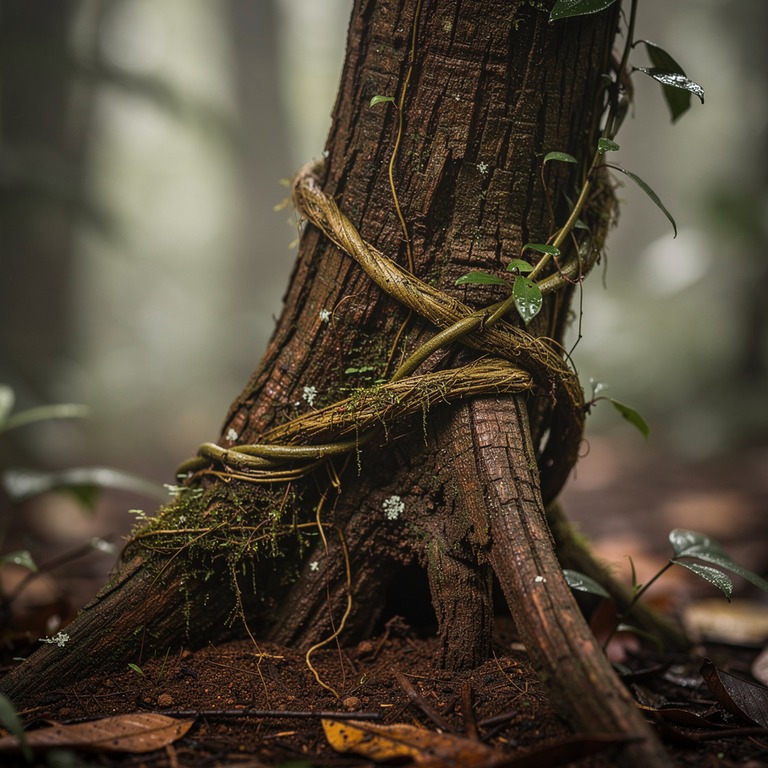
Ayahuasqueros will often tell you, if you push them, that they consider the vine — the caapi — to be the actual teacher plant. The chacruna leaf provides the visions, but the vine provides the guidance, the structure, the sense of being held. Take the vine away and you still have a psychedelic experience. You just don't have the same medicine.
This is not mysticism dressed up as pharmacology. There's some emerging research showing that harmala alkaloids in the caapi vine have their own effects on the brain — neurogenic, antidepressant, possibly relevant to addiction recovery. The MAO inhibition isn't just a delivery mechanism for the DMT. It's part of the story.
Smoked DMT, by contrast, is a solo flight. Fast, sharp, and often overwhelming. Some people find it clarifying. Others find it terrifying in a way they can't integrate afterward. Without a shaman singing you through it, without hours of gentle unfolding, without the somatic release of purging — you're on your own with whatever comes up. For some seekers this works. For most, it doesn't do what ayahuasca does.
What This Means If You're Considering a Retreat
If you're weighing an ayahuasca retreat because you've heard about DMT's potential for treating depression, trauma, or addiction, it's worth being clear about what you're actually signing up for. A legitimate ayahuasca ceremony is not a shortcut to a DMT breakthrough. It's a longer, slower, often harder process that includes physical discomfort, emotional release, and the presence of people whose job is to keep you safe while you do the work.
A few practical things to consider before you book:
- Lineage matters. Ask who trained the facilitators, and for how long. A curandero who apprenticed for fifteen years under a Shipibo maestro is not the same as someone who did an ayahuasca retreat once and started leading ceremonies.
- Screening matters. Reputable retreats will ask about your medications, your mental health history, and your reasons for coming. If nobody asks, that's a red flag.
- Integration matters. What happens in ceremony is maybe 30% of the work. The other 70% is what you do in the weeks and months after. A retreat that hands you a life-changing experience and then waves goodbye at the airport is doing half a job.
- Dieta and preparation matter. Traditional practice involves dietary restrictions, abstinence from other substances, and often plant dietas that prepare the body and mind. The two-week no-pork, no-alcohol prep isn't arbitrary — it shapes how you meet the medicine.
Where Smoked DMT Fits (and Where It Doesn't)
None of this is to say vaporized DMT has no value. Some people find it useful as a brief opening, a glimpse, a way to touch something they later go looking for more slowly. Underground therapists sometimes use it in short adjunctive sessions. There's genuine research being done into 5-MeO-DMT (a related but distinct molecule, often extracted from toad venom or synthesized) for treatment-resistant depression and end-of-life anxiety.
But if your goal is deep psychological work — the kind of thing people describe when they say ayahuasca helped them get sober, or process a childhood trauma, or find their way out of a decade of depression — you're going to want the container. The songs. The night. The purging. The people beside you who have done this thousands of times.
Master plants, in the indigenous framing, don't just give you an experience. They enter into a relationship with you. That relationship takes time. It takes multiple ceremonies, often across years. It takes listening to what the medicine actually says, which is often something less flashy and more uncomfortable than what you hoped to hear.
A Word on Risk and Honesty
Both smoked DMT and ayahuasca carry real risks, and anyone selling you a purely rosy picture is either inexperienced or lying. Ayahuasca can interact dangerously with SSRIs and other serotonergic medications — potentially fatal interactions, not just uncomfortable ones. Underlying psychiatric conditions like schizophrenia or bipolar disorder can be destabilized. Cardiovascular issues need to be screened for.
Beyond pharmacology, there are the human risks: unscrupulous facilitators, sexual misconduct in ceremony (which does happen and is well-documented in the retreat world), fly-by-night operators who set up shop in Costa Rica or Peru because plant medicine is trendy right now. Do your research. Read participant reports. Ask uncomfortable questions before you send money.
The plant is a teacher. But the humans running the ceremony are humans, and some of them are excellent and some of them are not. Choose carefully.
Coming Back to the Question
So — smoked DMT versus ayahuasca, indigenous shamanism's take? The tradition is largely silent on vaporized crystal because that isn't its tradition. What the tradition does say, loudly, is that the medicine is inseparable from the ceremony, the songs, the dieta, the relationship. Extract the molecule and you've got a fascinating chemical. Bring it into a maloca at midnight with a curandero who has been walking with the vine for forty years, and you've got something else entirely.
For readers who want to take this further, a range of curated ayahuasca and plant-medicine retreats can be browsed on our marketplace here. Whatever you decide, decide slowly. This isn't the kind of thing you want to rush.
Craving More Stories?
Join our ShopAyahuascaRetreats newsletter for the latest updates on thrilling
destinations and inspirational tales, delivered straight to your inbox!
We value your privacy. Your email address will never be shared or published.